VR GAME DEVELOPMENT

VR game development earned in production.

Current Sourcegarden Studio team members have taken a VR game from concept to commercial release, built a Meta-commissioned mobile VR shooter and solved the interaction, performance and multiplayer problems that appear when a real headset meets a real production.

Discuss your project
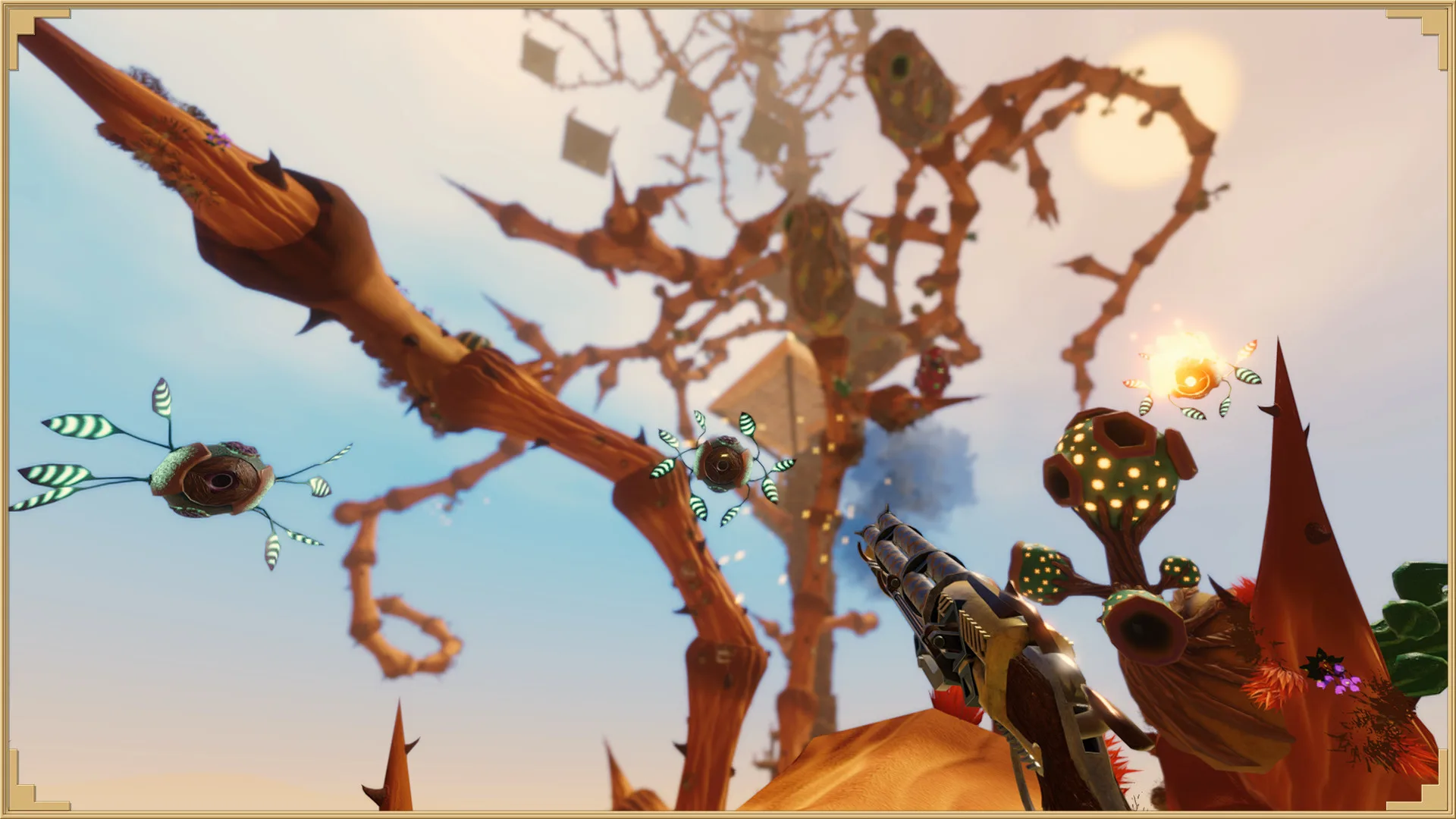
A player climbing through Beanstalker's large procedural VR world
Bean stalker · 60,000 copies sold · 90% positive Steam reviews
01

VR-first interaction, comfort and game feel

Virtual reality development begins with the player's body, reach, attention and available space. We design interaction as part of the core loop, with spatial feedback, traversal, object handling and input rules evaluated in the headset rather than adapted from flat-screen controls at the end.

Comfort is a product constraint. Locomotion, camera behavior, acceleration, scale and visual density must work together for the intended audience and session length. Prototypes test those assumptions early, while interaction systems remain data-driven enough for designers to tune them through production.

  • Tracked interaction and spatial feedback
  • Traversal and comfort options
  • VR-first gameplay systems
  • On-headset design validation
02

Performance on target headset hardware

Stable frame time determines both comfort and commercial viability. We set CPU, GPU, memory and loading budgets against representative hardware, then profile scenes and systems using repeatable scenarios. Optimization choices are measured in the context of the complete frame rather than treated as isolated code cleanup.

The team's evidence includes Beanstalker's four-kilometre procedural world at a 90+ FPS target and VOXSYS targeting 90 FPS on mobile VR hardware. That work required low-level optimization, Burst compilation, native containers and content rules that let a wider team create assets without silently breaking the budget.

  • CPU, GPU and memory profiling
  • Mobile and PC VR constraints
  • Unity Burst optimization
  • Performance-aware content pipelines
03

Procedural worlds and production pipelines

Immersive scale is expensive when every environment depends on one-off manual construction. Procedural generation can expand variety, but only when navigation, interaction, memory, art direction and testing are considered together. We design the runtime system and the authoring workflow as one production problem.

Bean stalker used a fully procedural vertical world while supporting an 18-person cross-functional team. The lesson is practical: tools, validation and build automation matter as much as the generation algorithm because content creators need fast feedback and the release team needs repeatable results.

  • Procedural environment systems
  • Designer-facing authoring tools
  • Asset and scene validation
  • Automated VR build pipelines
04

Multiplayer VR that remains immediate

VR multiplayer adds embodied motion and fine-grained interaction to the usual network problems. Authority, prediction, hand and object state, reconnect behavior and latency feedback must preserve both responsiveness and a trustworthy shared world.

Beanstalker's four-player co-op and VOXSYS's client-predicted competitive combat represent different solutions. We choose the multiplayer model around the game loop, number of players, target hardware and tolerance for divergence rather than forcing every VR product into the same networking pattern.

  • Co-op architecture
  • Competitive client prediction
  • Shared object and player state
  • Sessions, reconnects and diagnostics

COMMON QUESTIONS

What teams ask before we begin.

Does Sourcegarden Studio develop both standalone and PC VR games?

The documented team work includes commercial PC VR and performance-constrained mobile VR. We select architecture, content budgets and release workflows for the actual headset and storefront requirements of each project.

Can you join an existing Unity VR project for optimization?

Yes. We establish a reproducible profile on representative hardware, rank bottlenecks by player and comfort impact, and verify changes against the same scenario before recommending broader architecture work.

Do you build multiplayer VR experiences?

Yes. The team has delivered four-player co-op and client-predicted competitive VR work. We can own a complete multiplayer scope or a defined networking, session or dedicated-server layer.

START A CONVERSATION

Need a game development partner?

Bring Sourcegarden Studio an idea, a prototype, or a production already in motion. We’ll help define the right development scope.

Discuss your game